Exterior stinging insect nesting presents an immediate physical contamination and safety risk to Detroit homes, particularly on historical structures with multi-layer architectural woodwork. In neighborhoods like…
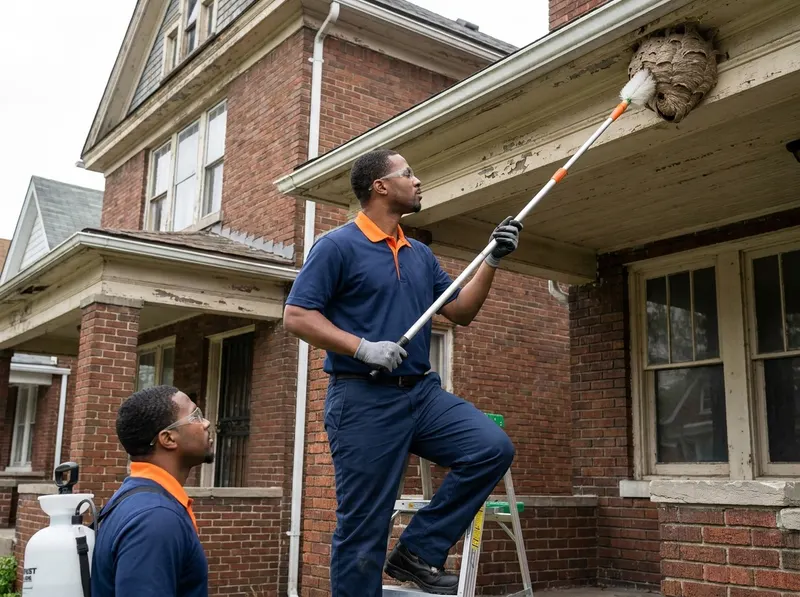
Exterior stinging insect nesting presents an immediate physical contamination and safety risk to Detroit homes, particularly on historical structures with multi-layer architectural woodwork. In neighborhoods like Boston-Edison, Indian Village, and Palmer Woods, deep roof overhangs, decorative fascia, and unsealed cedar soffits allow aerial colonies to anchor beneath gutters or penetrate into attic air gaps. In brick tudors throughout Rosedale Park and Bagley, yellowjackets consistently exploit failing mortar joints and open weep holes, constructing expansive subterranean or cavity nests within exterior masonry envelopes. In dense urban corridors such as Midtown, Corktown, and Woodbridge, proximity to high-foot-traffic sidewalks makes perimeter activity around porches, fire escapes, and bay windows a direct liability for residents and pedestrians.
A single mature paper wasp umbrella nest can harbor 20 to 50 active adults by late July, while baldfaced hornet nests attached to high tree limbs or eaves regularly expand to 14 inches in diameter with populations exceeding 400 workers. Ground-nesting and void-dwelling yellowjackets build colonies housing 1,500 to 4,000 individuals by September, generating steady defensive aggression. Standard store-bought aerosol sprays deliver low-pressure delivery streams that rarely penetrate deep internal comb networks, typically dispersing agitated insects outward or forcing them through interior wall cavities into living rooms and bedrooms. Decisive intervention utilizes micro-encapsulated synthetic pyrethroids combined with specialized pyrethrin formulations delivered under calibrated pressure through extension wands, instantly freezing worker movement before initiating complete physical extraction.
Technicians resolve structural risks through a three-step sequence: 1. Aerial visual triage maps active flight paths and locational voids along gutters, siding, and foundation perimeters. 2. Pressurized chemical knockdown delivers an immediate synthetic agent to collapse active defense within 60 seconds, followed by mechanical scraping of the attachment pedicle to strip residual pheromone cues. 3. Physical exclusion repairs, sealing gaps larger than 1/8 inch using non-shrinking silicone sealant, metal mesh backing, and copper mesh around brick weep vents to prevent re-establishment. If a colony is situated entirely within a wall cavity, technicians inject targeted insecticidal dust through existing masonry joints or discrete 1/4-inch access drillings rather than tearing open exterior trim boards, preserving the original facade while neutralizing the hidden core.
Every job gets a firm, written price after a free on-site visit.
Tell us about your exterior stinging insect & wasp hive neutralization job in Detroit and we'll send a clear, written quote, usually the same day.
 Fenvik Pest Response