Fenvik Pest ResponseFenvik Pest Response

Subterranean Termite Soil & Perimeter Treatment Detroit

Subterranean termites (Reticulitermes flavipes) cause deep structural destruction across Wayne County by accessing timber framing through microscopic cracks in poured concrete, stone mortar joints, and hollow masonry…
Get My Free Estimate →(231) 374-9109
Subterranean Termite Soil & Perimeter Treatment in Detroit, MI
Quick answer
  • Scope includes continuous exterior foundation trenching, mechanical sub-slab rodding, and focused injection of non-repellent liquid termiticide.
  • Target completion duration ranges between 4 and 8 hours for an average residential detached building footprint.
  • Ballpark investment ranges from the $250 inspection/spot minimum up to $2,500 for full perimeter containment.
  • The process targets subterranean termite colonies, mud shelter tubes, structural sill plate infestations, and damp ground-contact timbers.
  • Deployment scheduling occurs by direct dispatch inquiry via (231) 374-9109, with exact quotes verified on-site.

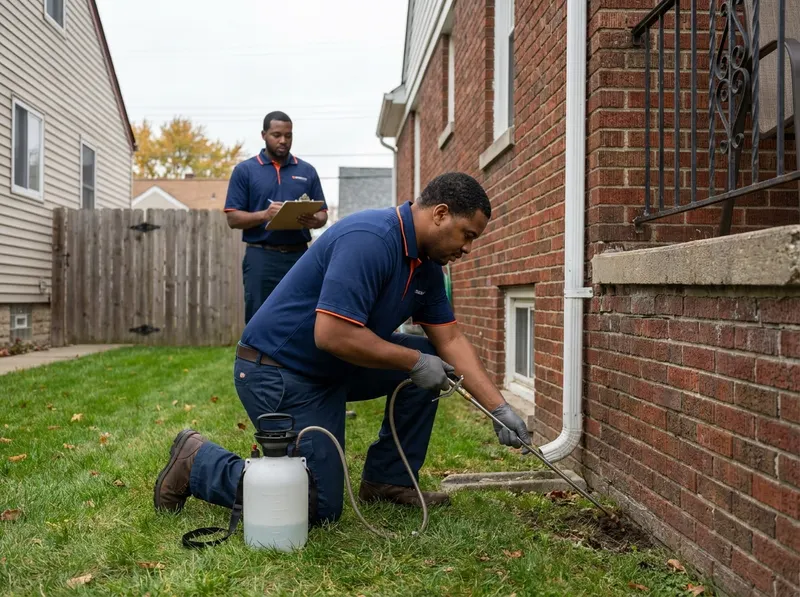
Subterranean termites (Reticulitermes flavipes) cause deep structural destruction across Wayne County by accessing timber framing through microscopic cracks in poured concrete, stone mortar joints, and hollow masonry blocks. Structures located in historic neighborhoods like Boston-Edison, Indian Village, and Palmer Woods frequently present aging Michigan basements, rubble-stone foundations, and direct structural wood-to-soil contacts. Liquid termiticide barrier treatment creates a continuous zone of treated earth surrounding the structural envelope. Technicians trench soil along foundation walls down 6 inches by 6 inches, saturate the backfill at 4 gallons per 10 linear feet per foot of depth, and rod-inject termiticide adjacent to the footing.

Selecting liquid chemical soil barriers provides immediate defensive advantages over slow-acting bait stations. In situations with verified internal infestation inside structural sills or floor joists, bait station systems require 60 to 180 days of continuous consumption before colony suppression occurs, during which structural feeding continues. A liquid perimeter barrier immediately terminates subterranean workers passing through treated soil while transferring active termiticide molecules across the entire colony via grooming behaviors within days. The trade-off involves invasive slab drilling: concrete porches, sidewalks, and interior basement floors must be drilled every 12 inches to saturate sub-slab gravel packs, which are subsequently sealed with hydraulic cement.

Clay-dense soils common to Detroit riverfront corridors and older residential districts such as Corktown, Woodbridge, and Midtown retain moisture, producing ideal conditions for subterranean swarmers in early spring. Houses on slab or crawlspace foundations throughout Bagley and Green Acres require specialized injection depth to prevent hydraulic wash-out along aging drainage tiles. Subterranean termite liquid remediation focuses exclusively on structural exclusion and colony termination, requiring no mandatory continuous monthly maintenance retainers. Treatment remains effective in the soil profile for 5 to 10 years depending on municipal soil moisture levels and localized excavation disturbance.

Subterranean Termite Soil & Perimeter Treatment cost in Detroit

Visual Inspection & Barrier Feasibility Spot Minimum$250 - $400
Targeted Exterior Soil Trenching & Localized Wall Injection$450 - $850
Full Perimeter Foundation Trenching & Rodding (up to 150 linear ft)$1,200 - $1,800
Comprehensive Historic Basement & Attached Slab Drilling Treatment$1,850 - $2,500

Every job gets a firm, written price after a free on-site visit.

Common questions

How much does subterranean termite soil treatment cost in Detroit?
Perimeter soil treatments in Detroit typically range from $1,200 to $2,500 for whole-home defense, with localized interventions starting at the $250 minimum depending on linear footage and drilling requirements.
How does foundation construction in Detroit affect subterranean termite treatments?
Rubble stone, fieldstone, and aged brick foundations found in Detroit neighborhoods like Indian Village require low-pressure injection drilling directly into mortar voids alongside exterior trenching to prevent termites from climbing internal wall channels.
What is the difference between termite bait traps and liquid soil treatments in Detroit?
Liquid treatments in Detroit place a continuous chemical barrier in the ground that kills termites quickly on contact, whereas bait stations rely on foraging termites discovering plastic cylinders over several months.
Will technicians drill through concrete slabs during a Detroit termite treatment?
Technicians drill 0.5-inch holes spaced 12 inches apart through exterior patios, driveways, garage slabs, or basement floors in Detroit properties to ensure chemical coverage under concrete, followed by immediate cement patching.
How fast do subterranean termites cause wood damage to Detroit structures?
A mature colony of 250,000 subterranean termites can consume the equivalent of two linear feet of pine framing lumber every 12 to 14 months inside an untreated Detroit home foundation.
Helpful resources

Trusted references & local links

USA.gov, government & consumer helpBetter Business BureauFTC Consumer AdviceU.S. Small Business AdministrationReady.govU.S. EPAENERGY STARU.S. Dept. of EnergyConsumer.govU.S. Census BureauGoogle Maps, Detroit, MI

Get started today

Tell us about your subterranean termite soil & perimeter treatment job in Detroit and we'll send a clear, written quote, usually the same day.

Get your free pest control service quote, Detroit

We only use your ZIP to check availability, no spam.